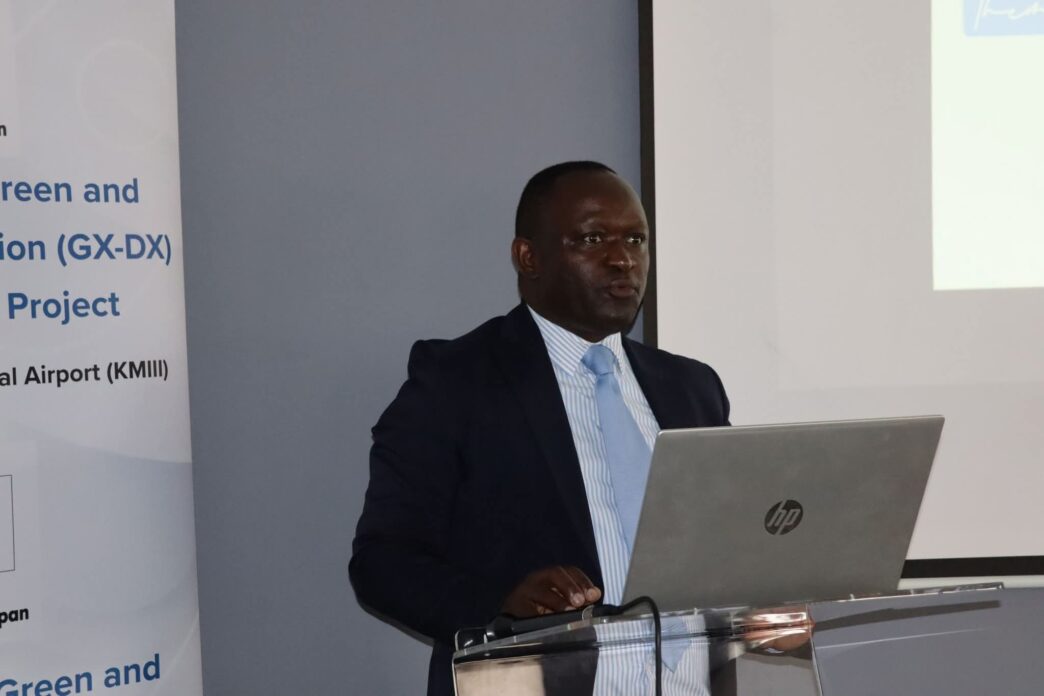
The Eswatini Civil Aviation Authority (ESWACAA) is targeting E12 billion in investment and 20 000 jobs through its new Airport City and Special Economic Zone master-plan centered at King Mswati III International Airport.
The figures were presented by ESWACAA Business Development Manager Richard Dlamini during the authority’s stakeholders forum held last Thursday, where he unveiled the authority’s long-term commercial and infrastructure strategy.
Dlamini said the plan is designed to transform the airport precinct from a traditional aviation facility into a fully integrated economic ecosystem that will drive private-sector investment, employment creation and local economic development.
According to his presentation, ESWACAA expects to attract E12 billion in investment via the SEZ and Airport City by 2037, while creating 20 000 direct and indirect jobs.
By the same year, the authority wants annual passenger traffic to reach 1.2 million, non-aeronautical revenue to account for 65 per cent of total revenue, airport operations to run on 100 per cent renewable electricity and 40 per cent of addressable spend to go to local SMEs. 
In the shorter term, the key objectives by 2037 include securing over E10 billion in private-sector investment, creating more than 15 000 direct and indirect jobs, handling over one million annual passengers, achieving net-zero operational emissions by 2045 and becoming a leading ESG-compliant aviation authority in Africa.
Dlamini told stakeholders that the core purpose of the strategy is to diversify revenue sources, reduce dependence on regulated aviation charges, become financially self-sustaining, develop environmentally sustainable infrastructure, promote inclusive economic growth, attract domestic and foreign investment and position Eswatini as a regional logistics and aviation hub.

He said the authority can no longer rely solely on aviation charges to sustain operations, hence the push towards commercial sustainability through commercial property, Airport City, retail, hospitality, parking, advertising and renewable energy.
The strategy is anchored on six strategic themes: Commercial Excellence, Sustainability, Innovation, Infrastructure Development, Partnerships and Inclusive Economic Development.
Dlamini said these will be guided by ten guiding principles which are financial sustainability, transparency and accountability, innovation, operational excellence, climate resilience, stakeholder collaboration, local economic empowerment, public-private partnerships, good governance and customer-centric service.
To deliver on the E12 billion investment and jobs target, ESWACAA has adopted eight strategic pillars.
Pillar One is Commercial Sustainability, which focuses on diversified revenue streams that reduce dependence on aviation charges.
Pillar Two is ESG Transformation, which will integrate Environmental, Social and Governance principles into every aspect of operations, including a green airport programme, solar energy, carbon reduction, waste management, governance and ESG reporting.
Pillar Three is the Airport Economic Zone, which Dlamini described as the heart of the jobs and investment drive. Airport land will be transformed into an integrated economic ecosystem comprising an SEZ, logistics parks, industrial parks, warehousing and business parks. It is from this zone that the bulk of the E12 billion investment and 20 000 jobs are expected to come.
Pillar Four is Local Economic Development, which ensures that airport investments stimulate inclusive growth. This will be achieved through SME development, local procurement, community investment, skills development and tourism promotion.
The remaining pillars focus on capability and delivery.
Pillar Five is Operational Excellence, which seeks to deliver safe, efficient and customer-focused airport operations through regulatory excellence, airport certification, service quality, digital transformation and process optimisation.
Pillar Six is Infrastructure Development, which will deliver the physical infrastructure that enables the strategy. Dlamini listed Airport City, cargo village, solar farms, hotels, a sanitary landfill, business parks and an aviation academy as priority projects.
Pillar Seven is Strategic Partnerships, which will mobilise government, investors, airlines, development finance institutions, universities, municipalities and tourism organisations to accelerate delivery and investment.
Pillar Eight is Institutional Excellence, which will build internal capability to execute and sustain the strategy through governance, human capital, financial management, innovation, risk management and performance management.
Dlamini further unpacked the implementation path in four phases.
From 2027 to 2029, under the BUILD phase, ESWACAA will focus on institutional foundations, quick-win revenue initiatives, building a project pipeline and putting in place an ESG framework.
From 2030 to 2033, in the COMMERCIALISE phase, Airport City Phase I will be rolled out, the SEZ will become operational, cargo growth will be prioritised and private capital will be mobilised.
From 2034 to 2037, in the EXPAND phase, the authority will scale Airport City, expand the SEZ, develop Maintenance, Repair and Overhaul (MRO) and logistics, as well as energy and local economic development projects.
From 2038 to 2046, in the INTEGRATE & LEAD phase, the ecosystem will mature, Eswatini will operate as a regional hub, ESG best practice will be entrenched and financial self-sustainability will be achieved.
Dlamini said if successfully executed, the plan will turn King Mswati III International Airport into an economic engine capable of creating thousands of jobs for Emaswati while attracting billions in investment, in line with the authority’s vision: ‘To the Sky Above, Let’s Fly!’