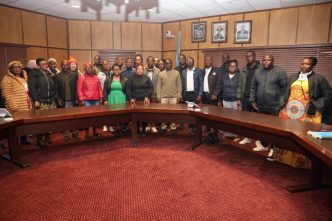

The government has engaged relevant regulatory and investigative authorities to examine allegations raised by former employees of The Luke Commission following a meeting with Prime Minister Russell Mmiso Dlamini on Monday, August 10, 2026.
A group of former employees of The Luke Commission visited the Private and Cabinet Office on Monday to present allegations concerning their experiences during their employment at the organisation.
According to Acting Government Spokesperson Thabile Mdluli, the former employees raised a range of concerns relating to labour practices, workplace treatment, governance, clinical operations and patient care. 
Mdluli said the allegations were serious and would be subjected to due process.
“The accounts presented were deeply troubling and, if substantiated through due process, would constitute matters of grave public concern,” Mdluli said.
The Luke Commission is an institution established to provide healthcare and humanitarian services to vulnerable members of society.
The government said the organisation therefore has a responsibility to uphold standards of professionalism, medical ethics, accountability and respect for human dignity.
The allegations presented by the former employees included claims of breaches of labour legislation and employment practices.
Among the claims were unlawful termination of employment, denial of due process, discrimination, victimisation and intimidation.
The former employees also alleged that some employees worked without written employment contracts.
They further claimed that employees were required to work excessive hours without lawful compensation.
According to the government, the former employees also alleged that there was a workplace culture in which staff were discouraged from asserting their statutory labour rights.
The former employees also raised concerns about governance and operational practices at The Luke Commission.

They alleged that certain individuals performed clinical functions without the required professional qualifications or registration.
They further alleged that employees were instructed to undertake medical responsibilities beyond the scope of their competence.
The former employees also raised allegations relating to patient care and the handling of medicines and food products.
According to the allegations, expired medicines and food products had their expiry dates altered before being administered or distributed to patients and vulnerable beneficiaries.
The former employees also alleged that medicines intended for veterinary use were administered to patients by individuals who were neither medical doctors nor registered nurses.
Other allegations included claims that patients were, on some occasions, retained in care for longer than was medically necessary.
The former employees further alleged that there was a persistent disregard for accepted medical protocols and professional codes governing healthcare practitioners.
The government said these allegations would be examined through the appropriate processes.
The former employees also alleged instances of racism and unequal treatment in the workplace.
They reportedly raised further concerns about intimidation and statements suggesting that legal remedies available under Eswatini’s labour laws would be ineffective.
The allegations included references to proceedings before the Commission for Mediation, Arbitration and Litigation (CMAC).
According to the former employees, statements were allegedly made suggesting that pursuing matters through CMAC would not be effective.
The government said employees’ rights would be considered as part of the process.
“Behind every allegation is a human being whose dignity, livelihood and wellbeing matter,” Mdluli said.
She added that whether an employee, patient, caregiver or elderly citizen receiving assistance, every liSwati is entitled to be treated with dignity, fairness, compassion and respect under the law.
The former employees also raised allegations concerning advocacy efforts linked to the government funding.
According to the statement, employees were further subjected to pressure to participate in campaigns intended to influence the government funding decisions.
The former employees reportedly claimed that they were encouraged to lobby Members of Parliament to raise matters in Parliament.
They also alleged that they were instructed to participate in public advocacy efforts. In addition, they claimed that employees were encouraged to develop adverse perceptions of Government officials who were seeking greater transparency and accountability regarding public resources.
The government said these allegations would also be considered as part of the investigations.
The government said it had engaged the appropriate regulatory and investigative authorities to examine the allegations.
The investigations are expected to establish the facts surrounding the claims.
Mdluli said the process would be conducted independently and without fear or favour.
“Equally, the government recognises that these allegations must be tested through lawful and independent processes,” she said.
“No conclusions will be drawn before the relevant authorities have had the opportunity to establish the facts objectively and impartially.”
The government said that where evidence establishes misconduct or violations of the law, appropriate corrective, regulatory and legal measures would be pursued in accordance with the laws of Eswatini.
At the same time, the government said the process would provide The Luke Commission with an opportunity to clear its name against any information that may be unfounded or misleading.
The government said institutions providing healthcare and humanitarian assistance occupy a position of public trust.
It said such institutions are expected to comply fully with the laws of Eswatini, professional standards governing medical practice, labour legislation and ethical obligations towards patients and employees.
The statement stated that the government remained committed to protecting patients, safeguarding the rights of employees and ensuring that institutions entrusted with serving the people of Eswatini operate with integrity, professionalism, accountability and compassion.
The government revealed that the matter would continue to be followed until the facts had been established.
“The people of Eswatini deserve healthcare institutions they can trust,” the government said.
It added that preserving that trust requires transparency and accountability, as well as action where credible evidence establishes wrongdoing.