
The Ministry of Economic Planning and Development, through its Macroeconomic Analysis and Research Unit,
has officially compiled and produced the 2026Q1 Economic Bulletin, presenting a detailed look into the nation’s current financial trajectory.
The Ministry has provided a simplified breakdown of the key highlights from the review period. 
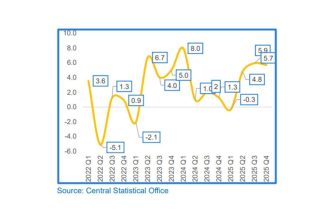
Key among these indicators is that Eswatini’s economy grew by 5.7% in the last quarter of 2025, showing remarkable resilience and proving the country is moving forward despite intense international pressures.
Furthermore, domestic inflation remains low at 1.9%, meaning the general cost of living did not rise heavily, as price increases for food, housing and utilities remained calm.
Financial indicators also reveal more support for local enterprises, as private sector credit increased by 3.3%, with businesses borrowing 6.9% more, particularly in the manufacturing and construction sectors to help drive job creation.
On the currency front, the Lilangeni gained value and appreciated against major global currencies, including the US Dollar, British Pound and Euro.
Despite these successes, the bulletin notes a few challenges, including a small trade deficit where imports slightly outpaced exports, alongside ongoing tensions in the Middle East that continue to create international uncertainty.
Overall, the latest bulletin demonstrates that Eswatini’s domestic economy continues to show structural resilience against external shockwaves, maintaining a stable and hopeful outlook for the future.

Looking at the broader international landscape, the Ministry’s research unit highlights renewed vulnerability across major global markets,
where rising tensions in the Middle East and fluctuating international trade policies have collectively dimmed growth prospects.
While global economic activity rose by 3.4% in 2025, outperforming initial forecasts due to favourable tech investments, the medium-term outlook has been revised downward.
Global output growth is projected to decelerate to 3.1% in 2026, reflecting a 0.2 percentage point downward revision relative to earlier estimates, before experiencing a minor recovery to 3.2% in 2027.
Advanced Economies are forecasted to experience flat growth, stabilising at 1.8% in 2026 and dipping further to 1.7% in 2027. Within this bloc,
the United States economy is projected to expand by 2.3% in 2026, supported by improved fiscal policies and the lagging effects of 2025 monetary policy rate cuts,
while the Euro Area faces contractionary pressures, with GDP anticipated to decline by 1.1% in 2026 and 1.2% in 2027.
In Emerging Market and Developing Economies, growth is projected to slow to 3.9% this year before rising to 4.2% in 2027.
The ongoing Middle East crisis is expected to adversely affect these developing nations through diminished financial flows, reduced remittances and heightened energy dependence,
though China remains an outlier with growth projected at 4.4% due to domestic stimulus measures designed to mitigate external shocks.
At the regional level, economic growth in Sub-Saharan Africa is projected to remain steady at 4.3% in 2026 and 4.4% in 2027, though the ministry warns of an emerging divergence between nations.
Oil-importing countries face severe headwinds due to the ongoing energy crisis, while major oil exporters like Nigeria are expected to sustain a growth rate of 4.1% in 2026 due to improved macroeconomic stability.
Crucially for Eswatini, South Africa, the country’s primary regional trading partner, is experiencing a significant economic slowdown.
Due to structural challenges and disruptions linked to global conflicts, South Africa’s economic growth is forecasted to decline to 1.0% in 2026, with only a modest rebound to 1.3% anticipated in 2027.
This stagnation directly impacts external demand and trade balances within the Common Monetary Area, putting further pressure on Eswatini’s cross-border commercial dynamics.