
The Deputy Prime Minister, Thulisile Dladla, has officially launched the Agriculture Sector Review and the Agricultural Solutions Marketplace on Wednesday.
The DPM described the event as a milestone in the government’s effort to build a modern, competitive and resilient agricultural sector.
The launch took place at Happy Valley during the National Strategic Dialogue: Transforming Agriculture and Agribusiness in Eswatini. 
The dialogue was jointly hosted by the Ministry of Agriculture and the World Bank Group. Dladla represented Prime Minister Russell Mmiso Dlamini at the event.
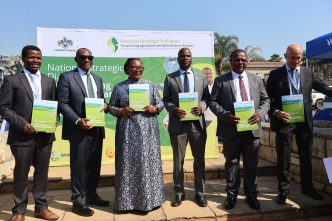
She was accompanied on a tour of agricultural projects by Minister of Agriculture Mandla Tshawuka, Minister of Commerce, Industry and Trade Manqoba Khumalo and Minister of Finance Neal Rijkenberg.
In her address, Dladla said agriculture remains central to national development. She noted that the sector provides livelihoods for thousands of emaSwati, underpins food sovereignty, contributes to employment, and drives rural development.

She also outlined persistent challenges affecting the sector. These include the impact of climate change, low productivity, fragmented value chains, limited value addition, inadequate access to finance and constrained market opportunities.
Dladla said the Agriculture Sector Review launched provides the government with an evidence-based roadmap for transformation.
According to her, the document identifies areas where institutions must be strengthened, service delivery improved and strategic investment directed to enable farmers and agribusinesses to thrive.
She said the Review is aligned to three national frameworks, which are the National Development Plan 2023-2028, the Programme of Action for the same period and the Eswatini National Agricultural Investment Plan, INAP 2.0.
The agricultural components of those frameworks seek to improve food sovereignty, increase productivity, create employment, promote agri-processing and strengthen resilience to climate change.
Dladla emphasised that transformation will require collaboration beyond government.
She listed the private sector, financial institutions, development partners, research institutions, farmer organisations and local communities as critical stakeholders.
The Deputy Prime Minister said the Agricultural Solutions Marketplace was designed to move beyond identifying problems.

She stated that the platform showcases technologies, business models and partnerships that have demonstrated results and can be scaled to improve productivity, strengthen value chains and create employment.
She called for increased adoption of innovation in the sector, including digital agriculture, precision farming, climate-smart technologies, mechanisation, improved irrigation, modern livestock production, biotechnology, and efficient post-harvest management.
Dladla further stressed the need to develop agri-processing industries to add value to agricultural products before they reach domestic and international markets.
On investment, Dladla said the government remains committed to creating an enabling environment for agricultural investment and will participate directly where necessary.
She said agriculture must become an attractive business capable of generating sustainable returns, creating jobs and improving livelihoods.
To achieve this, she called for expanded access to affordable finance, stronger agricultural insurance and risk-sharing mechanisms, investment in rural infrastructure, improved logistics and policies that encourage private investment and public-private partnerships.
She urged financial institutions, investors and development partners to work with the government to unlock opportunities across agricultural value chains. Priority commodities identified include grains, livestock, horticulture and industrial crops.