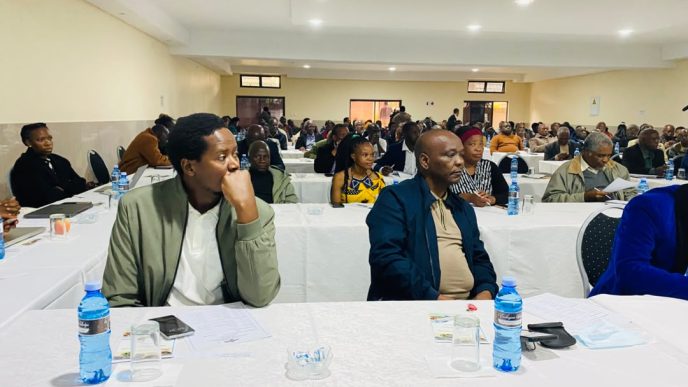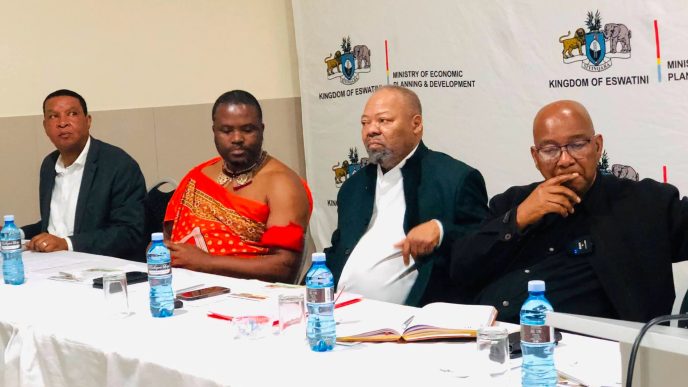

Prime Minister Russell Mmiso Dlamini on Monday received a delegation from the Environmental Investment Fund of Namibia, EIF,
as government moves to transform the Eswatini Environment Fund into a larger institution capable of mobilising significant financing for sustainable development.
The delegation, led by EIF Chief Executive Officer Benedict Libanda, is in the country to conduct a preliminary assessment on how Eswatini can restructure its fund following Cabinet’s approval for its transformation. 

During the courtesy visit, Libanda briefed the Prime Minister on Namibia’s experience in establishing and scaling the EIF.
He said the fund has mobilised approximately E27 billion since its establishment and has financed projects across several sectors.
These include sustainable agriculture with a focus on drought-resistant crops and livestock,
waste management, biodiversity conservation, marine projects, renewable energy and carbon markets.
Libanda explained that a key feature of the Namibian model is its partnership with commercial banks.
The EIF provides risk-mitigation instruments that de-risk lending and facilitate access to finance for members of the public and businesses undertaking sustainable development projects.

He further informed the Prime Minister that the EIF recently secured US$1 billion from the Climate Investment Fund.
The package comprises US$20 million in grants and the remainder as credit facilities for businesses.
Presenting preliminary findings of the assessment, Libanda said Eswatini has significant opportunities to develop a similar financing model.
He identified renewable energy as a priority area, stating that solar energy could form an important component of a strengthened environmental investment financing model for the country.
Other areas highlighted include sustainable agriculture and environmental conservation. The delegation noted that these sectors align with existing national policies but require larger-scale funding to achieve meaningful impact.
Libanda said the full assessment will consider Eswatini’s institutional, legal and market environment to determine the most suitable structure, whether a replication of the Namibian model or a hybrid approach.
The Prime Minister welcomed the insights shared by the Namibian delegation and expressed appreciation for the technical support.
He said government looks forward to receiving a concept note from the EIF outlining options for Eswatini.
The concept note is expected to provide recommendations on how the country can develop a fund that meets its unique development needs while attracting both domestic and international climate finance.
“We appreciate the experience that Namibia is sharing. We await the concept note that will guide us on the next steps,” the Prime Minister said.
Minister of Tourism and Environmental Affairs Jane Mkhonta-Simelane informed the Prime Minister that the Eswatini Environment Fund and the EIF are already working on a Memorandum of Understanding aimed at formalising cooperation between the two institutions.

She said the MoU will focus on strengthening collaboration, technical assistance, capacity building, and joint resource mobilisation.
According to the Minister, the partnership is expected to enhance Eswatini’s capacity to mobilise climate finance and unlock investment in priority areas.