By Delisa Magagula
The President of the Institute of People Management (IPM), Sharon Maziya, has raised alarm over the growing cases of sexual harassment in Eswatini’s workplaces.
Maziya has revealed that 28 cases have been reported since January 2025. Even more concerning, she highlighted that 60% of companies in the country do not have policies in place to combat workplace harassment. 
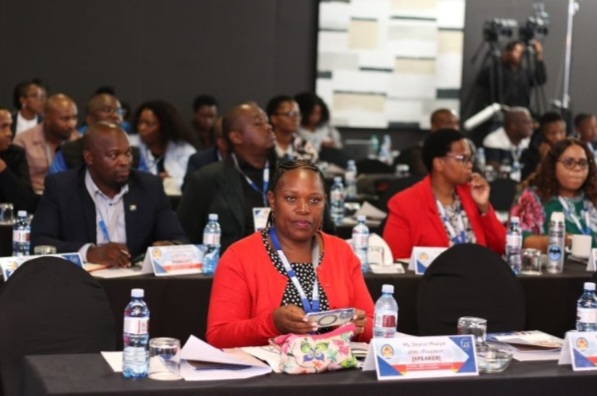
Maziya made these revelations during the Conciliation, Mediation, and Arbitration Commission (CMAC) 2025 Annual Labour Law Seminar, held at Happy Valley Hotel, where she stressed that the current statistics were likely an underrepresentation of the true scale of the problem.
“There is a serious problem in the kingdom with reports of sexual harassment in the workplace. This is a controversial topic, and we need to talk about it. Looking at the statistics, we see that in January, we had 12 reports of sexual harassment 11 female and one male. In February, we had a massive jump, with 15 females and one male reporting cases. This is unacceptable, and we cannot work like this,” she stated.
The IPM president further emphasized Eswatini’s alignment with the International Labour Organization (ILO), which the kingdom joined in 1968 upon gaining independence.
She noted that ILO standards define workplace bullying as repeated, unreasonable, and harmful behaviour that threatens an employee’s mental, physical, or emotional well-being, as well as their safety.
“Bullying takes many forms, including belittling remarks, assigning unfair tasks, withholding important information, verbal abuse, humiliation, intimidation, and exclusion,” Maziya explained, adding that these behaviours have also been classified by the European Agency for Safety and Health at Work as serious threats to employee well-being.
Despite the rise in cases, Maziya revealed that only 40% of companies in Eswatini have anti-sexual harassment policies, leaving a vast majority of employees vulnerable to workplace misconduct.
“Unfortunately, a massive 60% don’t have these policies in place. As an organization, we propose a safe, respectful, and dignified environment for all employees. Bullying comes in many forms, and we even see it happening on social media, which is a growing concern,” she said.
She also addressed a shifting workplace dynamic where men have expressed concern about the increasing empowerment of women in recent years.
“We have heard men asking what they can do with these recently empowered women because, over the last 15 years, society has been empowering women, but men have been left behind,” she noted. Maziya concluded her address by calling for stronger support systems for victims of harassment and bullying.
“Victims of harassment and bullying should be given support and education coupled with counselling because they are not the cause of the bullying or the harassment,” she said.