
















EWADE’s partnership help advance six UN Development goals for Eswatini
By Lwazi Dlamini
Eswatini Water and Agricultural Development Enterprise (EWADE) strategic Memorandum of Understanding (MoU) will help Eswatini achieve six of the United Nations’ Sustainable Development Goals. (UN SDGs).
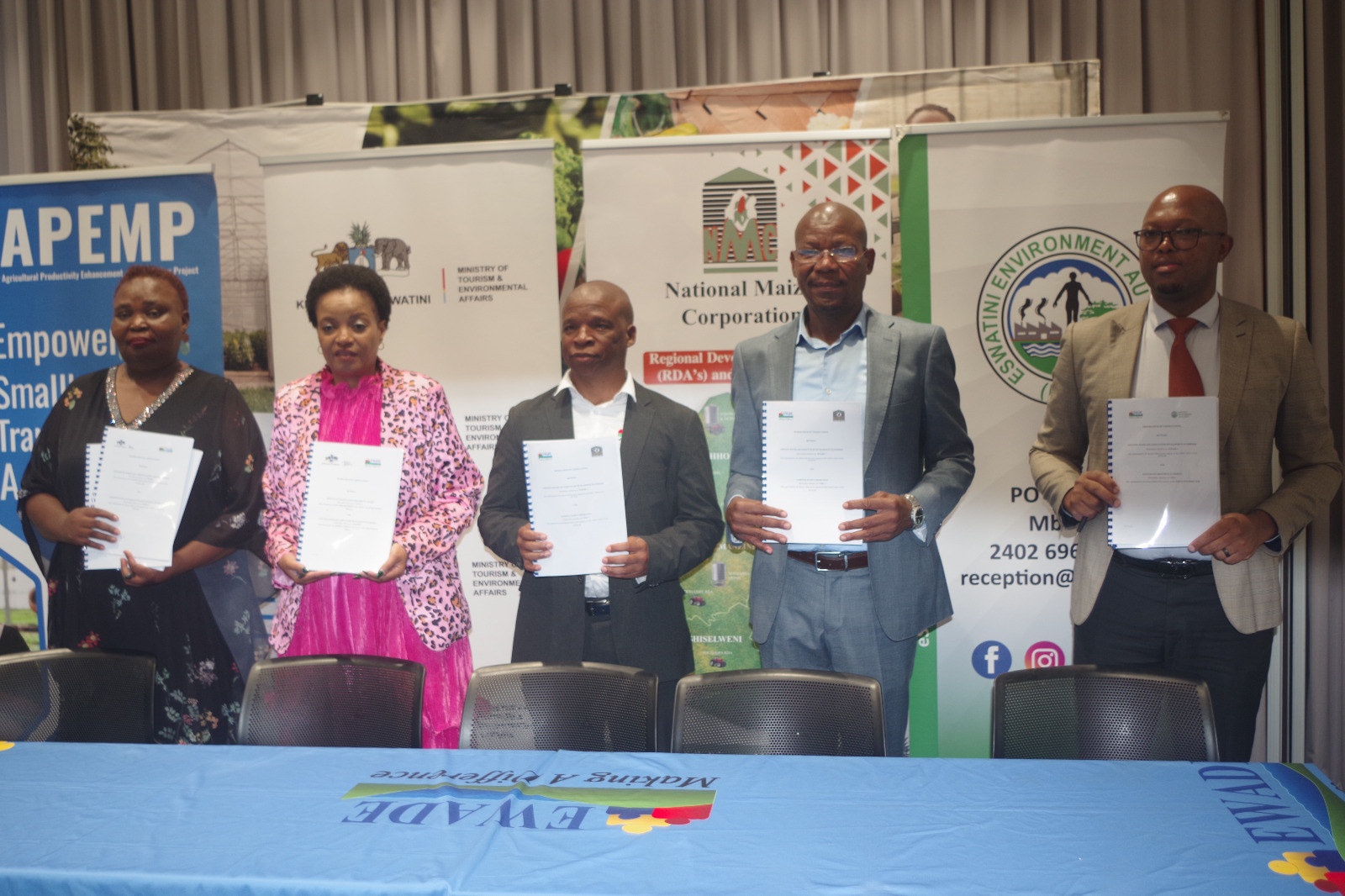
This was an observation made by EWADE CEO Dr. Samson Sithole during the signing of the latest MoU with the National Maize Corporation (NMC), Eswatini Environment Authority (EEA), Ministry of Tourism and Environmental Affairs (MTEA) and the Ministry of Tinkhundla Administration and Development (MTAD) on Tuesday, 16 December 2025 at Hilton Garden.
“Today’s MoUs represent more than general agreements; they are national development instruments. They are a declaration of our shared intent to empower smallholder farmers, strengthen value chains, and unlock the full potential of our rural economies. It is firmly aligned with the Eswatini Agriculture Sector Strategic Plan (2024 -2028), our National Development Strategy, and Vision 2050. It also advances several of the United Nations Sustainable Development Goals (SDGs),” Sithole said.
He named some of the UN Sustainable Development Goals as follows:
SDG 1: No Poverty: Uplifting rural communities through increased incomes.
SDG 2: Zero Hunger: Enhancing food security and nutrition.
SDG 5: Gender Equality: Empowering women as key actors in agribusiness.
SDG 8: Decent Work and Economic Growth: Fostering jobs, especially for youth, through agribusiness ventures.
SDG 13: Climate Action: Embedding climate-smart agriculture in all aspects of production.
SDG 17: Partnerships for Goals: Strengthening collaboration among government, private sector, development partners, and farmers.
Sithole said the MoU also formalizes the strategic partnership and the shared commitment towards collaboration, coordination, and impact.
“It moves our cooperation from ‘good intentions to structured action’.
On 16th September 2025, EWADE signed the first batch of MoUs with key strategic partners, namely, Ministry of Agriculture, Deputy Prime Minister’s Office and NAMBoard.

This partnership responds directly to the needs of smallholder farmers by ensuring alignment with institutional mandates, resources, and expertise.
Today we are excited to sign the second batch of MoUs which speaks to our commitment to transparency, accountability, and results through collaboration and coordinated implementation,” Sithole said.
He added: “The Memorandum of Understanding that we sign today are not in isolation, they align directly to the Smallholder Agriculture Productivity Enhancement and Marketing Project (SAPEMP), officially unveiled by the Honourable Minister for Agriculture, Mandla Tshawuka, on March 27, 2025,”
Sithole said the MoUs are therefore, a practical expression of SAPEMP’s vision, providing the framework through which we will translate policy into coordinated action, and ensure that the promise of this national programme is realized in tangible benefits for our farmers, communities, and the economy at large.
“The challenges facing smallholder farmers productivity, market access, climate resilience and knowledge gaps cannot be addressed in isolation. SAPEMP was designed to also promote and integrate multi-stakeholder solutions.
These partnerships respond directly to that need by aligning mandates, resources and expertise. The MoU represent a framework for collaboration, innovation, and coordinated implementation,” Sithole noted.
He stated that the objectives of the project are to increase smallholder farmers’ production, nutrition, and incomes, and to build their
esilience to climate change through 3 components, which include:
Component 1: Production and Productivity Improvement of the Target Value Chains
Subcomp 1.1: Cluster-based support for market-led production and behavioral change and nutrition.
Subcomp 1.2: Infrastructure Investments for agricultural commercialization.
Component 2: Improving Market Linkages and Access to Finance
Subcomp 2.1: Capacity building of clusters and entrepreneurship businesses.
Subcomp 2.2: Market linkages through demand-driven long-term offtake arrangements with AEs.
Component 3: Improved enabling environment for promotion of production and marketing of local produce
Subcomp 3.1: Country level policy advocacy
Subcomp 3.2: Project Management
Sithole said SAPEMP aligns with Eswatini’s National Development Strategy, the Ministry of Agriculture’s Strategic Plan, and global commitments such as the Sustainable Development Goals (SDGs), particularly in areas related to poverty reduction, food security and climate action.
“By leveraging public-private partnerships, SAPEMP is set to transform smallholder farming into a competitive, resilient, and market-driven sector, contributing to national food sovereignty, rural employment, and climate resilience,” he said.

Sithole said EWADE is proud to be the implementing agency of the Smallholder Agriculture Productivity Enhancement and Marketing Project (SAPEMP) as the project, supported by the Government of Eswatini, IFAD, and the Green Climate Fund, is designed to transform the lives of over 19,600 smallholder households – reaching nearly 117,700 people across all four regions of the Kingdom.
“As EWADE, we fully recognise a fundamental truth: no institution can achieve transformation alone. The future of agriculture lies in shared resources, coordinated action, and collective accountability.
By joining forces with the National Maize Corporation, Eswatini Environment Authority, Ministry of Tourism and Environmental Affairs, Ministry of Tinkhundla Administration and Development, and our valued partners, we are creating a holistic ecosystem that supports farmers from production to market,” he stated.
Sithole further stated that these partnerships reflect the best of collaborative governance, anchored in complementarity (not competition) where every institution contributes its unique strength towards a shared national vision.
“Let today be remembered not just for the signing of important documents, but rather the start of meaningful action. The signing of these MoUs must not end as a symbolic gesture.
It must mark the beginning of transformative action for the farmers that we represent today. Together, let us deliver tangible results at farmer level, where our impact matters most and strengthen coordination across institutions.
Work together to commercialize smallholder agriculture and build resilient, market-driven farming systems,” he concluded.