




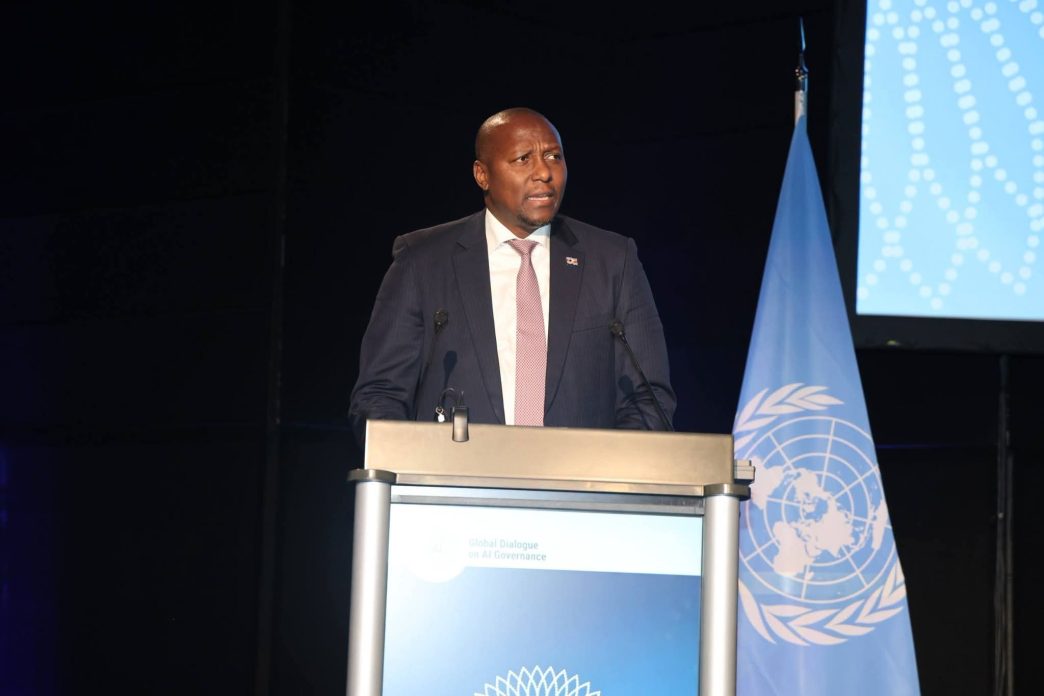
. . . PM calls for human-centred AI governance at Geneva Summit
Prime Minister Russell Dlamini has called for Artificial Intelligence governance that prioritizes human dignity and the practical needs of citizens, saying technology must serve people rather than dictate development outcomes.

The Prime Minister delivered the remarks on behalf of His Majesty King Mswati III during a high-level plenary session at the Global Dialogue on AI Governance in Geneva, Switzerland. The dialogue was held under the theme ‘Harnessing the Benefits of AI Through Inclusive and Intraoperative Approaches.’
The PM said for countries such as Eswatini, AI governance must begin with the principle that technology should improve daily life and strengthen public institutions.“Technology must serve people. It must improve daily life, expand opportunity, support the digitisation of essential public services and strengthen the institutions that serve our citizens,” he said.
He identified key areas where AI can support national development, including food security, healthcare, education, public administration, climate resilience, job creation and sustainable economic growth. “Artificial Intelligence is no longer a distant innovation. It is already shaping how we learn, govern, trade, communicate, heal, produce food and protect our environment,” the Prime Minister stated. “The question before us is therefore not whether AI will change our societies, but whether we will guide that change in a manner that protects human dignity, strengthens development and preserves the diversity of the human family.”
Dlamini cautioned against a one-size-fits-all approach to AI. He said AI tools, data and development pathways must reflect different cultures, languages and social contexts. “AI must not be allowed to narrow the world into a single understanding of progress, identity or values,” he said. “Responsible AI should not drive humanity towards one homogeneous coalescence. It should enable diverse, relevant and locally meaningful outcomes.”
He emphasized that small and developing states must not become only consumers of technology developed elsewhere.“We must not become mere consumers of technologies designed elsewhere, trained on realities unlike our own and deployed without regard to our development priorities,” he said. “We must be supported to build sovereign capability, local innovation, digital literacy, research capacity, computing access and trusted data ecosystems. Equitable growth in AI requires equitable capacitation.”
The Prime Minister further outlined steps already taken by government. He said Eswatini’s National Fourth Industrial Revolution Strategy promotes responsible human-machine collaboration. The country is investing in digital skills, including coding, data science and AI training for young people. Specialized expertise is also being developed through national institutions of learning.
“These efforts are guided by the conviction that automation must enhance human potential without undermining dignity, employment, social cohesion or cultural identity,” he said.
The premier said innovation cannot progress without public trust. He called for AI systems to be bound by human rights, safety, transparency and fairness standards. “AI governance must be human-centric in design, deployment and accountability,” he said. “Algorithms must be required to adhere to human rights, safety, transparency, fairness and public interest standards.
AI systems must not self-regulate, nor should they be permitted to determine their own growth paths outside clear human authority. Human judgement, responsibility and oversight must remain at the centre.”
“The protection of minors is paramount, children must be allowed to develop as children: protected from manipulation, exploitation, unsafe content, harmful profiling, addictive design and the premature shaping of their identities by systems they cannot fully understand,” mentioned the Prime Minister.
He further mentioned that no society should outsource childhood, learning or moral formation to machines.
The PM concluded that if governed correctly, AI can support service delivery and economic growth. If not, he warned, it risks deepening inequality.


