













Landmark AU–ECOSOC Meeting Strengthens Civil Society Role in Peacebuilding

By Kwanele Dhladhla
The Kingdom of Eswatini this week hosted a landmark gathering that is expected to significantly reshape the role of civil society in safeguarding peace and stability across Southern Africa.
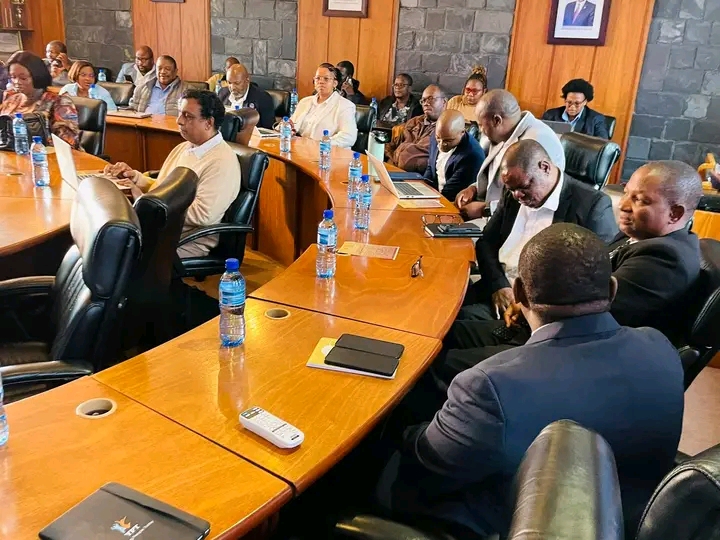
From August 25–28, 2025, government representatives, regional think tanks, and members of civil society organizations (CSOs) converged in Mbabane for a four-day workshop on Strengthening Early Warning and Government Monitoring Mechanisms in Southern Africa, co-convened by the African Union (AU) and the Economic and Social Council (ECOSOC), with technical facilitation by Thinking Africa.

The meeting was hailed as a critical milestone in institutionalizing partnerships between CSOs, governments, and continental bodies tasked with preventing conflict and building peace.
Speaking during a courtesy visit by the delegation, Minister of Foreign Affairs and International Cooperation, Senator Pholile Shakantu, applauded the workshop’s outcomes and stressed the strategic importance of the gathering.
“This meeting is integral to the African Peace and Security Architecture (APSA) and the Continental Early Warning System (CEWS), which is tasked with leading conflict prevention efforts, supported by Regional Economic Communities (RECs) and Regional Mechanisms (RMs),” Shakantu said.
She emphasised that Article 12 of the AU Peace and Security Council Protocol mandates CEWS to collaborate directly with civil society for data collection, analysis, and rapid response. This, she noted, places CSOs at the heart of Africa’s security framework.
“Civil society is often the first to detect signals of instability within communities. By strengthening their capacity and linking their insights to continental strategies, we make our early warning systems timelier, people-centered, and effective,” Shakantu explained.
Minister Shakantu further reminded participants of recent AU resolutions underscoring the importance of grassroots engagement.
“During its 1163rd Ministerial Meeting, the AU Peace and Security Council highlighted the urgent need for inclusive, community-based approaches to address Africa’s peace and security challenges. It recognised that socio-economic development and peace are inseparably linked, and that civil society organizations play a critical role in fostering social cohesion and preventing conflict,” she said.
Her comments echoed the central themes of the workshop, which emphasized the empowerment of CSOs as frontline actors in mediation, digital monitoring, and community mobilization.
One of the workshop’s key achievements was the formalization of the Southern Africa CSO Early Warning Coalition. The coalition will act as a regional hub for information-sharing, conflict monitoring, and early alerts.
Participants also collaborated on designing regional digital tools to track early warning signals and coordinate responses. Training sessions covered conflict analysis, mediation, and data protection – equipping CSOs with the technical skills needed to play a structured role in Africa’s evolving peace and security architecture.
Dr. Said Abass Ahamed, Director of Thinking Africa and lead facilitator of the workshop, hailed the Mbabane meeting as “a transformational step that elevates civil society from the margins to the center of peacebuilding in Southern Africa.”
For Eswatini, hosting the meeting underscored its growing role in continental and regional diplomacy. Shakantu stressed that Eswatini would continue to support efforts that reinforce dialogue, inclusivity, and preventive diplomacy.
“Lasting peace cannot be imposed from the top down. It must be nurtured from the ground up, informed by local realities and strengthened by continental collaboration,” she said.
By the conclusion of the meeting, participants had developed a framework for ongoing collaboration between state institutions and CSOs, reaffirming their shared commitment to the AU Silencing the Guns by 2030 initiative, the SADC Strategic Indicative Plan for the Organ (SIPO II), and the AU Women, Peace and Security (WPS) and Youth, Peace and Security (YPS) Agendas.
The Mbabane workshop has been described by participants as a turning point in how governments and civil society work together to prevent conflicts before they erupt. By bridging local knowledge with continental frameworks, the region now has a more inclusive roadmap for addressing its complex peace and security challenges.
As Minister Shakantu concluded, “This meeting has laid a strong foundation for structured collaboration. It is now upon us—governments, civil society, and regional bodies—to deliver on this vision and ensure that peace becomes a permanent reality in Southern Africa.”