













Asilwi nemasontfo – Princess Lindiwe
 The Minister for Home Affairs Princess Lindiwe addressing the different religious bodies gathered at the Ministry of Commerce Auditorium on Wednesday.
By Delisa Magagula
The Minister for Home Affairs, HRH Princess Lindiwe, has reiterated that government is not in conflict with churches but seeks to formalise their operations through a unified national policy.
Speaking during a stakeholders’ meeting of religious representatives at the Ministry of Commerce Auditorium on Wednesday, the Minister said her Ministry’s goal is to ensure all religious institutions operate under one recognised framework.
“We are not fighting with churches. What we want is to formalise and legalise their framework,” said the Minister.
Princess Lindiwe explained that the Ministry intends to create a structured motherboard that will guide all churches under one policy. This, she said, will help address the current lack of coordination in the registration and regulation of churches.
The Home Affairs Ministry maintains that its approach is administrative, not spiritual. Officials emphasise that formalisation will safeguard freedom of worship while ensuring accountability and transparency within faith-based organisations.
On Monday the Minister revealed that government will not be regulating churches as a new policy for religious institutions is being developed.
This followed an announcement by the minister that churches’ registration will now be under the Ministry of Home Affairs after the enactment of the proposed policy currently being developed through consultations.
The pronouncement by the minister is expected to allay fears that government had plans to regulate churches.
The ministry then held consultations at the Ministry of Commerce, Industry and Trade’s Auditorium at the Interministerial Building in Mbabane where hundreds of representatives from the different Christian fraternities and denominations gathered for the crucial stakeholder meeting aimed at discussing the development of the comprehensive policy to govern religious institutions in Eswatini.
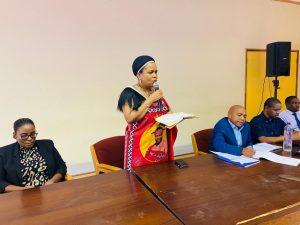
Princess Lindiwe, in her remarks on the mandate of the meeting, said the ministry’s aim was not to regulate churches, but wants churches to continue to operate independently in all aspects, even in terms of the sermons preached.
“We are aware that in some countries churches are regulated such that the kinds of sermons delivered are also regulated by government. In some cases, officers are even sent to stand guard and observe whether services are conducted according to government policy and that is not our aim,” said the minister.
She further said their aim was not to impose on the teachings in churches, but churches would continue to regulate themselves.
The minister emphasised that the role played by the ministry was mainly bringing order and churches will continue to be accountable and regulated by their mother bodies. These are the Council of Churches, League of Churches and the Conference of Churches.
According to the minister, the Ministry of Home Affairs had given itself an assignment of responsibility.
“Religious institutions lacked order, as there was no clear system as to the number of churches in the country and a comprehensive system that identifies each church under a certain denomination. We are devising a policy that will bring clarity and order,” she said.
She further highlighted that while the registration of churches is currently done under the Ministry of Commerce, Industry and Trade, which registered denominations as non-governmental organisations (NGOs), this policy would ensure that churches are back under the Ministry of Home Affairs.
“The aim is not to divide churches nor cause conflict, but to make a clear distinction of the churches found in the country and further to create order in the affiliations,” she said.
Worth noting is that these engagements were facilitated by the Ministry of Home Affairs to get feedback from churches on how best the policy can address issues of importance in matters of faith and the operations of religious entities therein.