











D-Day for Salary Review Talks
…Unions to Table Submissions Monday, Cabinet to Decide Tuesday.
By Kwanele Dhladhla
Eswatini 44,000 civil servants are set to finally hear the outcome of crucial, long-
delayed salary review talks this week.
A reliable source within the Ministry of Public Service has confirmed that public sector
unions will finally table their submissions on the proposed salary review this coming
Monday.
The deadline had initially been set for Friday, but unions requested more time,
prompting the government to extend it.
“The unions are expected to present their submissions on Monday. Cabinet will then
deliberate on the matter on Tuesday,” the source revealed.
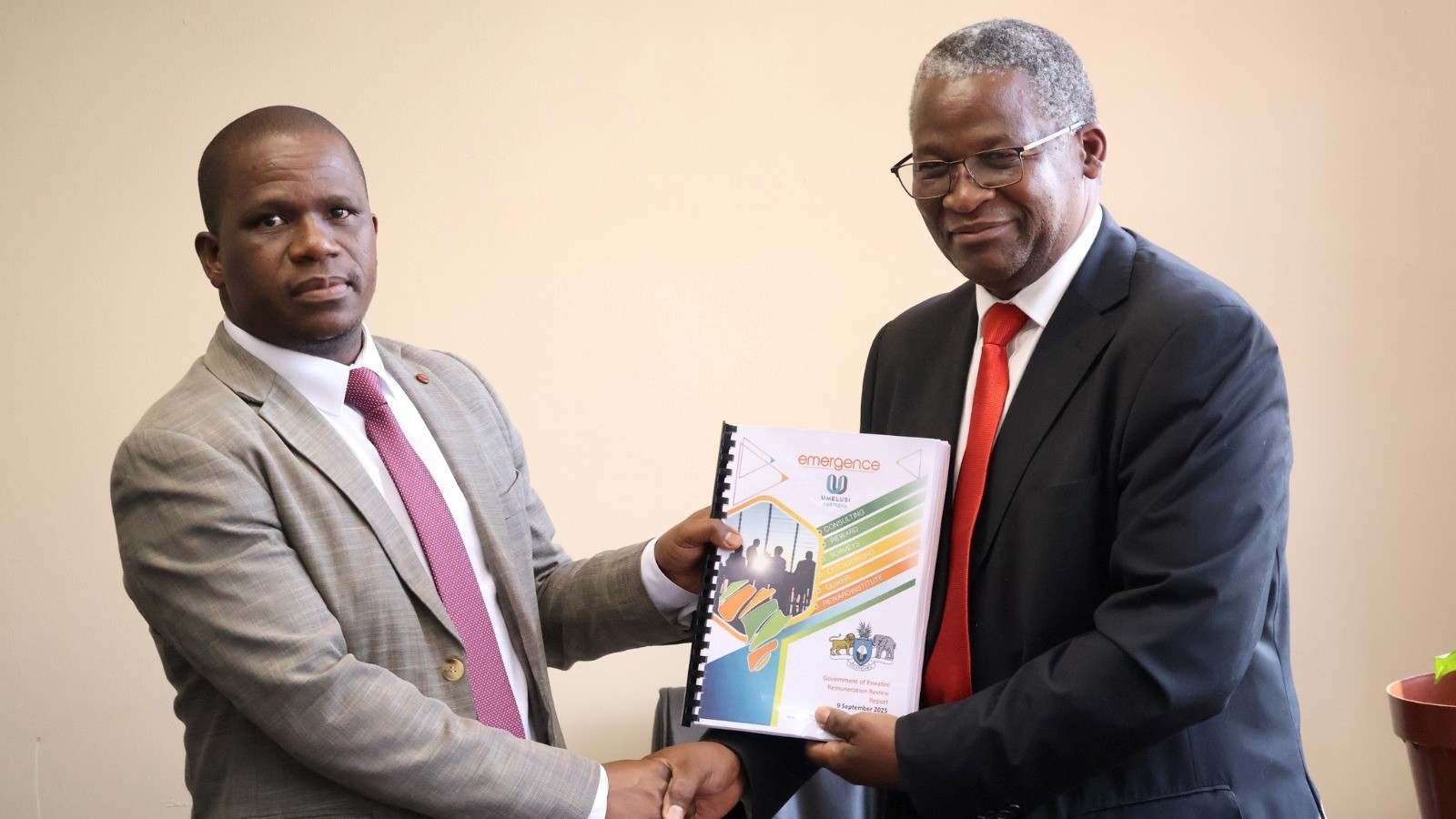
The talks follow the official handover of a 444-page Remuneration Review Report to the
Ministry of Public Service, prepared by consultants. Principal Secretary Mthunzi
Shabangu received the report at a recent Joint Negotiation Forum meeting.
The report makes it clear that the bulk of civil servants will see no movement in their
grading. According to the findings, 75 per cent of grades will remain unchanged, while
19 per cent will be upgraded and six per cent downgraded.
Among those facing a downgrade are the Handicraft Officer II, who would move from
Grade C3 to C2, and the Gender Analyst in the Office of the Deputy Prime Minister, who
is proposed to shift from Grade E3 to E2. Unions have voiced concerns that the review
should uplift all workers and not result in demotions, emphasizing that proposed
downgrades undermine morale and job security.
The Swaziland National Association of Teachers (SNAT) has been vocal about
additional allowances. Secretary General Lot Vilakati insists that plain clothes, housing,
and teaching allowances should be built into the review.
He acknowledged the introduction of a hardship allowance for teachers in special
schools but said more must be done. “Government declared those schools inclusive,
which means they can now admit any learner. However, teachers in these institutions
face unique challenges, which warrant a specific allowance,” Vilakati said.
The hardship allowance, set to come into effect in October, will equal five per cent of a
teacher’s basic salary for those working in rural or remote areas. Meanwhile, the travel
allowance is set to jump from 17 cents to 76 cents per kilometre, though the claim
radius has controversially been increased to 17 kilometres.
Vilakati also criticised the hiring of qualified teachers under Grade B2 – a category
meant for unskilled labourers. “If government has no post for C3, then it should hire
teachers who are diploma holders. Grade B2 is for unskilled workers, not trained
professionals,” he argued.
The remuneration review also covers politicians, commissioners, and security
personnel. The report proposes capping politicians’ communication allowance at E120
per month, alongside an entitlement of three per cent of basic salary for household
expenses when posted away from home.
Contractual employees will benefit from an ex-gratia allowance of 25 per cent of basic
salary to offset retirement provision gaps.
For teachers, a special responsibility allowance has been proposed – E600 for primary
school teachers and E800 for secondary school teachers – to compensate for extra
duties such as physical education, cultural programmes, and career guidance.
Police detectives and other plain-clothes officers may also see their monthly plain-
clothes allowance double from E100 to E200, reflecting the cost of civilian attire
compared to standard uniforms.
While unions gear up to table their submissions on Monday, all eyes will turn to Cabinet
on Tuesday, when the final deliberations begin. The stakes are high, as civil servants
await clarity on how much relief – or disappointment – the long-awaited salary review
will bring.
For now, the verdict is clear: the review may adjust allowances and tweak some grades,
but most civil servants will remain where they are. Whether unions can sway the
government to expand the scope of benefits will be determined in the coming crucial
days.