












CBE maintains interest rate
By Delisa Magagula
The Central Bank of Eswatini (CBE) has opted to maintain the discount rate at 6.75 percent, following the Monetary Policy Consultative Committee (MPCC) meeting held on August 1, 2025.
The Bank cited both global and domestic economic indicators, including inflation, growth forecasts, and financial stability objectives, in reaching its decision.
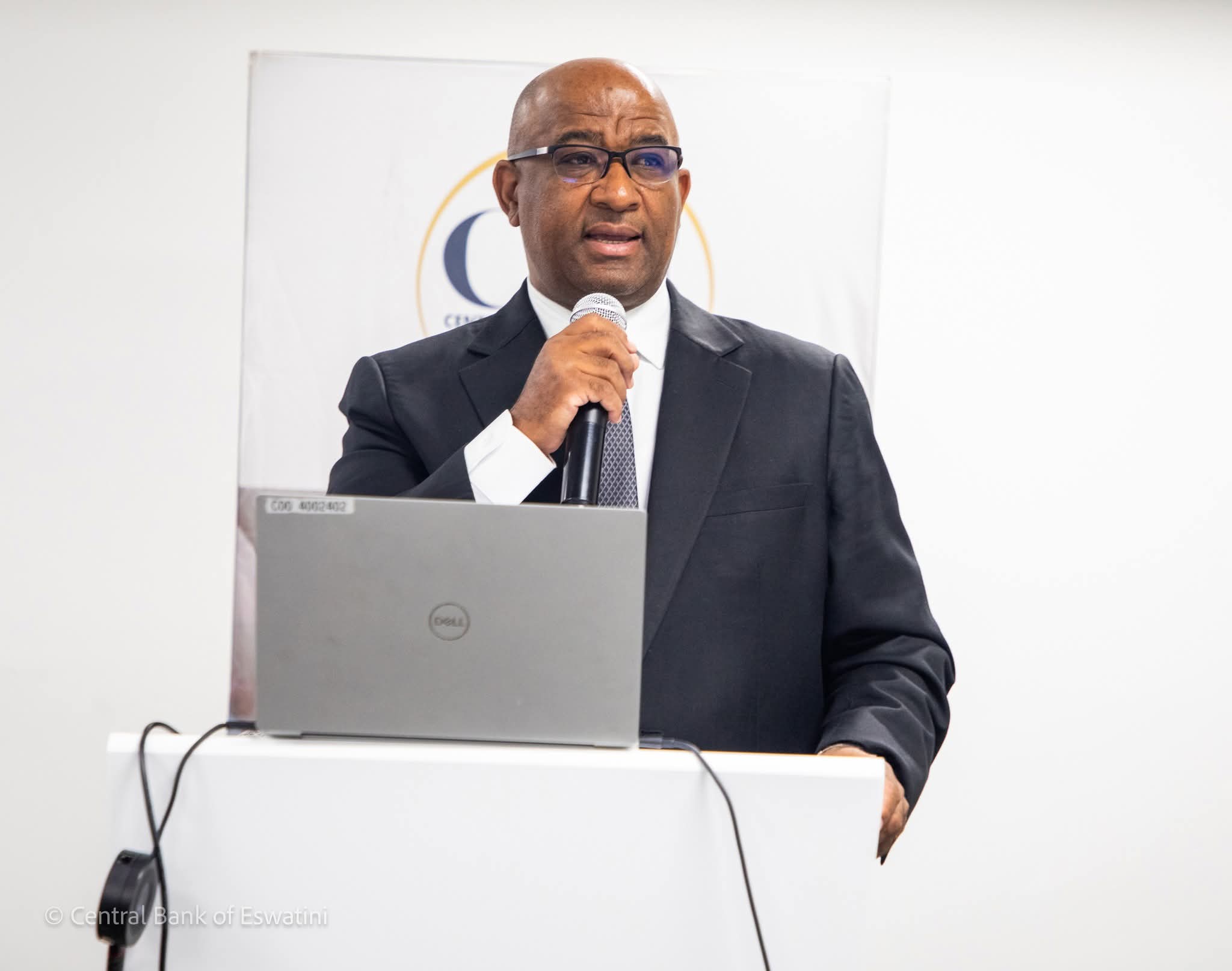
In a statement signed by Governor Dr. Phil Mnisi, the CBE noted that banks are expected to maintain the prime lending rate on loans extended to individuals and businesses at 10.25 percent until further notice.
Headline inflation in Eswatini decreased to 2.9 percent in June, down from 3.2 percent in May. The Central Bank attributed this decline to lower inflation in food, transport, and miscellaneous goods categories.
Looking ahead, the Bank projects headline inflation to average 3.6 percent in 2025 and 3.4 percent in 2026, revising down from 3.8 and 3.6 percent respectively.
“The downward revision was mainly due to lower-than-expected inflation outturns in recent months and slower global food prices.” reads the statement in part.
However, risks remain, including potential currency depreciation, elevated international food prices, and volatile energy prices.
According to the statement, Eswatini’s economy showed signs of slowing, with the Quarterly Gross Domestic Product (GDP) recording a 0.3 percent year-on-year decline in Q1 of 2025, following a revised growth of 1.7 percent in the previous quarter.
The slowdown was largely due to contractions in the secondary and tertiary sectors, particularly manufacturing and wholesale trade.
The Central Bank warned that local economic activity remained somewhat subdued, despite minor improvements in agriculture and government services.
Globally, the International Monetary Fund (IMF) made marginal adjustments to economic forecasts, revising global growth upward to 3.0 percent for 2025 and 3.1 percent for 2026.
Advanced economies are expected to see slightly better outcomes, while emerging markets including Eswatini may experience modest rebounds.
Closer to home, South Africa’s economy grew by 0.1 percent in Q1 of 2025. However, the South African Reserve Bank (SARB) trimmed its 2025 and 2026 growth projections due to persistent inflation pressures.
The SARB also kept its interest rate steady at 8.25 percent in July. The CBE noted, South Africa’s inflation slightly eased in June 2025, and risks to inflation are now considered more balanced than before.
In terms of credit, private sector credit grew 0.5 percent month-on-month in June, driven by higher credit to households.
However, non-performing loans (NPLs) increased to 7.0 percent, up from 6.8 percent in May. Meanwhile, gross official reserves stood at E11.3 billion, equivalent to 2.4 months of import cover.
Although this marked a slight drop from E11.6 billion in May, it still exceeded the CBE’s minimum target of 2.0 months of import cover.
Governor Mnisi stated that the Bank cautiously considered the credibility of the peg against the South African Rand and emphasized that it would continue monitoring both domestic and international economic developments.
He concluded that the Bank remains focused on maintaining price and financial stability to support Eswatini’s economic development.