














Eswatini pushes for inclusive refugee policies, crisis support
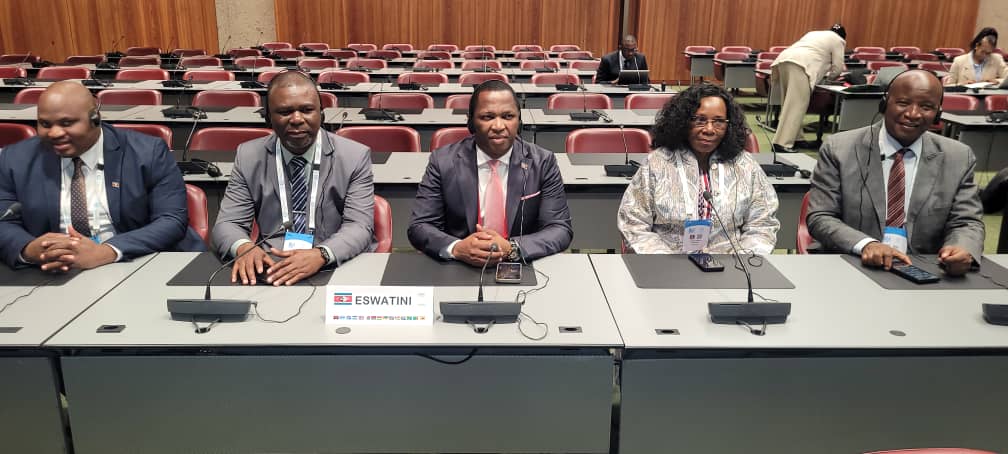 Speaker of the House of Assembly of Eswatini Jabulani Mabuza delivered a compelling and comprehensive address at the 151st Assembly of the (IPU)
By Siphesihle Dlamini
Speaker of the House of Assembly of Eswatini Jabulani Mabuza delivered a compelling and comprehensive address at the 151st Assembly of the Inter-Parliamentary Union (IPU) in Geneva, Switzerland, emphasising the urgent need to uphold humanitarian norms and support humanitarian action amid global crises.
The Assembly, convened under the theme “Upholding Humanitarian Norms and Supporting Humanitarian Action in Times of Crisis,” is a vital platform for parliamentary leaders worldwide to engage in dialogue, share perspectives, and forge collaborative responses to humanitarian challenges.
The Speaker opened his remarks by drawing attention to the profound connection between humanitarian norms and the United Nations’ Agenda 2030 for Sustainable Development.
He explained that while the agenda does not explicitly contain a chapter titled “humanitarian norms,” it adopts “a transformative and universal approach that links humanitarian action to sustainable development.
” Central to this framework is the principle of “leaving no one behind,” which, according to the Speaker, “requires humanitarians and development actors to work together to address the root causes of crises.”
This principle, he emphasised, mandates prioritising the most vulnerable and marginalised groups, including migrants, refugees, and internally displaced people.
The Speaker elaborated on the key humanitarian norms reinforced by the 2030 Agenda, highlighting three pillars:
Leaving no one behind: This principle reinforces the commitment to prioritise vulnerable populations, ensuring that humanitarian efforts reach those most in need.
Universal human rights: Grounded explicitly in international human rights standards, humanitarian aid and sustainable development must be guided by a human-rights-based approach, with success measured by the extent to which individuals can enjoy their rights.
Gender equality: Assistance and protection must consider the specific needs and vulnerabilities of women and girls in crises, including safeguarding them from violence and exploitation.
Mabuza further invoked the leadership of His Majesty King Mswati III, recalling the King’s call during the 78th session of the UN General Assembly for “collective action on both domestic and international actors to work together in crises such as pandemics and natural disasters.” This call for solidarity and cooperation resonates deeply with the Assembly’s objectives.
Turning to the legal foundations of humanitarian norms, the Speaker noted that they are “grounded mainly in international humanitarian law, the body of law that regulates the conduct of hostilities and,
to an extent, in international human rights law as it continues to apply in times of armed conflict.” These norms include vital protections such as shielding civilians from attack, safeguarding those not engaged in fighting, and facilitating the delivery of humanitarian aid.
A poignant segment of the speech addressed the ongoing threat posed by nuclear weapons. Marking the 80th anniversary of the nuclear detonations in Nagasaki and Hiroshima, Speaker Mabuza warned that “the risk of using nuclear weapons is higher than ever before.”
He described the prohibition and elimination of nuclear weapons as “a humanitarian imperative,” emphasising that “a nuclear conflict would have catastrophic effects on human health, the environment, the climate, food production and socio-economic development.”
Eswatini’s commitment to this cause is demonstrated by its piloting of the ‘Nuclear Radiation and Safety Bill,’ a legislative initiative aimed at enhancing nuclear safety and humanitarian protection.
The Speaker also paid tribute to the International Committee of the Red Cross (ICRC), describing it as “the only institution explicitly named under international humanitarian law as a controlling authority.”
He highlighted that the ICRC’s “legal mandate stems from the four Geneva Conventions of 1949, as well as from its own statutes,” and that its continued relevance lies in its mission “of protecting the lives and dignity of victims of war and internal violence and providing them with assistance.”
On the practical dimension of humanitarian action, Mabuza defined it as “providing timely, needs-based assistance to save lives and alleviate suffering through a range of activities such as delivering food, water, shelter, and medical care.”
He clarified that this assistance is “a short-term, emergency response to disasters, conflicts, and health crises,” with the goal of helping affected individuals “maintain their dignity and return to a normal life.
” He highlighted Eswatini’s own collaborative approach through its National Disaster Management Unit, which coordinates efforts to provide such assistance during emergencies.
Addressing the plight of asylum seekers and refugees, the Speaker explained that Eswatini’s refugee regime “encourages asylum seekers and refugees to integrate into society and they peacefully live alongside the host community.
” He added that “asylum seekers and refugees are allowed to work,” reflecting the country’s inclusive and humane policies.
In closing, Honourable Mabuza urged the Assembly to embrace four fundamental humanitarian attributes:
Save lives: Provide immediate support to prevent loss of life and suffering.
Alleviate suffering: Focus aid on reducing the impact of crises on affected populations.
Maintain human dignity: Ensure the basic needs and dignity of those affected are protected.
Provide impartiality: Deliver assistance based solely on need, without discrimination based on ethnic origin, gender, or ideology.